An AI Scribe is a useful starting point- although the more useful journey starts in the handover before and after the consultation
The harder problem starts once the consultation is over, because the information then must survive the rest of the system.

The journey only starts at the scribe output
AI scribes have been getting a lot of attention in medicine, and I think that’s fair enough. Clinical documentation can be burdensome—no doubt about that one—and when software can capture a consultation accurately and give a useful, informative draft without forcing the clinician to spend half the encounter looking at a keyboard, that’s a real improvement. But the claims of hours saved per day have been overblown, with a lot of marketing wind.
We use that intuitive technology ourselves, and it clearly has a place. But I don’t think note generation is the main information problem to now fix in interconnected healthcare.
The harder problem starts once the consultation is over, because the information then must survive the rest of the system. A patient might see their GP, then a specialist, have imaging or pathology, enter a public or private hospital, pass through an emergency department, undergo a procedure, move through several nursing shifts and eventually return to community care. Every step generates information, but the important question is whether the meaning of that information survives as it moves.
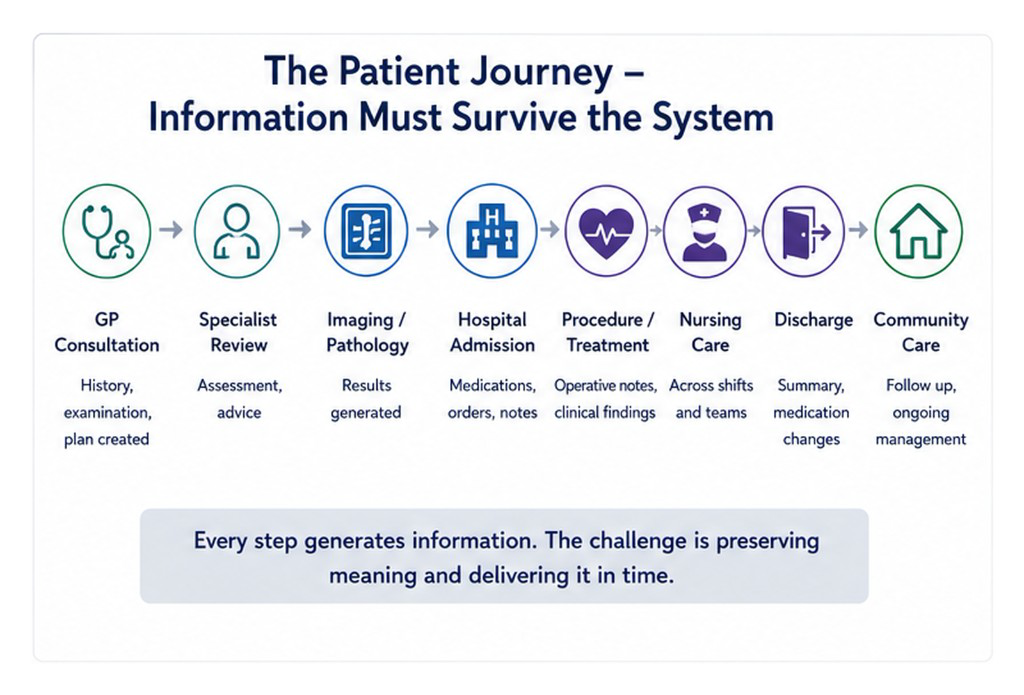
The information has to survive every transition in the patient’s care.
I’ve seen this fail in all sorts of ordinary ways over the years. A result is there, but the next clinician doesn’t know it’s there. A medication has been changed in hospital, but the community list still says something different. A specialist letter contains exactly the right information, but it arrives after someone has already had to make the next decision. A concern is picked up on one nursing shift and is much less obvious by the next morning. Usually nobody has done anything obviously wrong. The system has simply allowed the information to degrade.
Healthcare certainly doesn’t suffer from a shortage of data. We produce enormous amounts of it, but having information somewhere in the record isn’t the same as having the right information available to the right person at the right point in care. That’s why we keep coming back to two ideas at Regenemm: fidelity and latency.
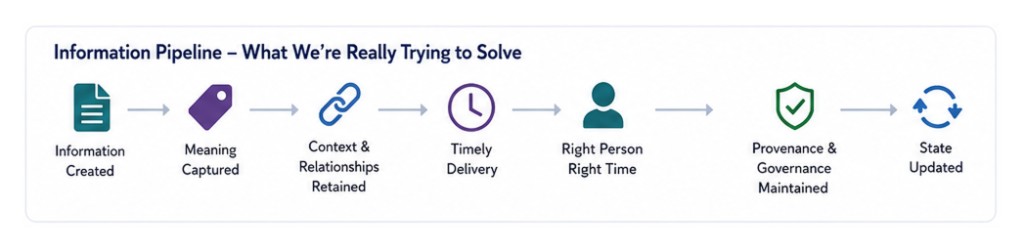
Useful information keeps its meaning, context, provenance and timing as it moves.
By fidelity, I mean preserving the clinical meaning. If a patient previously had left leg weakness and now says it’s resolved, the useful information isn’t just the word “weakness”. The side matters, the timing matters, and whether it was something the patient reported or something that was actually examined - matters. If there was imaging or another clinician’s assessment that influenced the interpretation, that matters too.
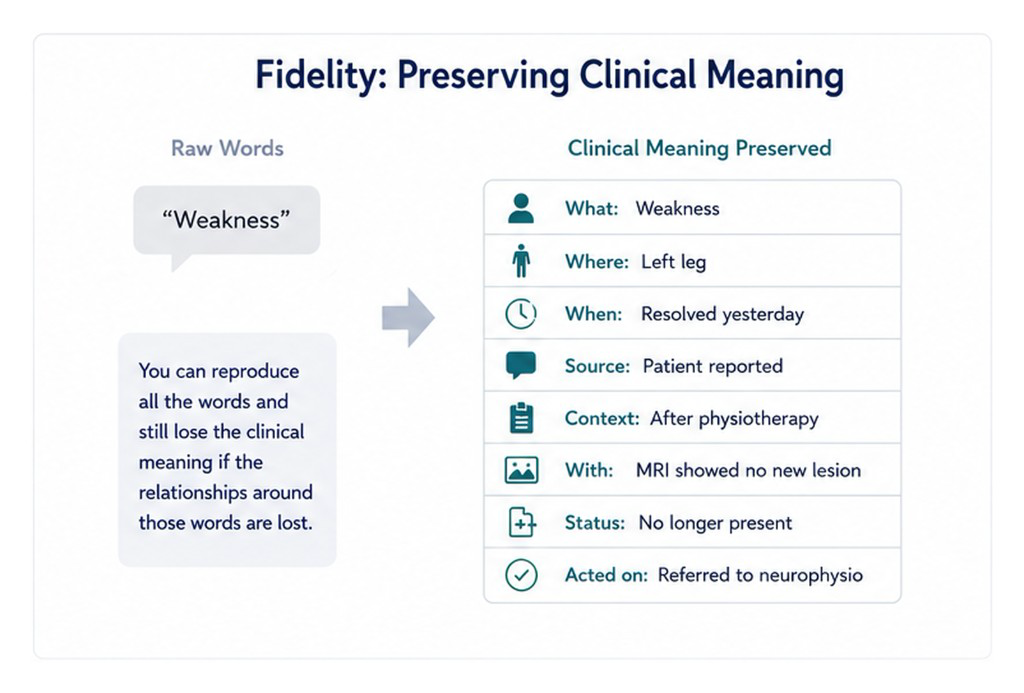
Clinical meaning sits in the relationships around the words, not in the words alone.
You can reproduce all the words and still lose the clinical meaning if the relationships around those words are lost. Latency is the other part of the same problem. Information must arrive while it’s still useful. A beautifully prepared specialist letter that reaches the GP three weeks after the relevant decision was made is still a good letter, but it’s less useful than the same information arriving promptly. The same applies to results, discharge information, medication changes and handover.
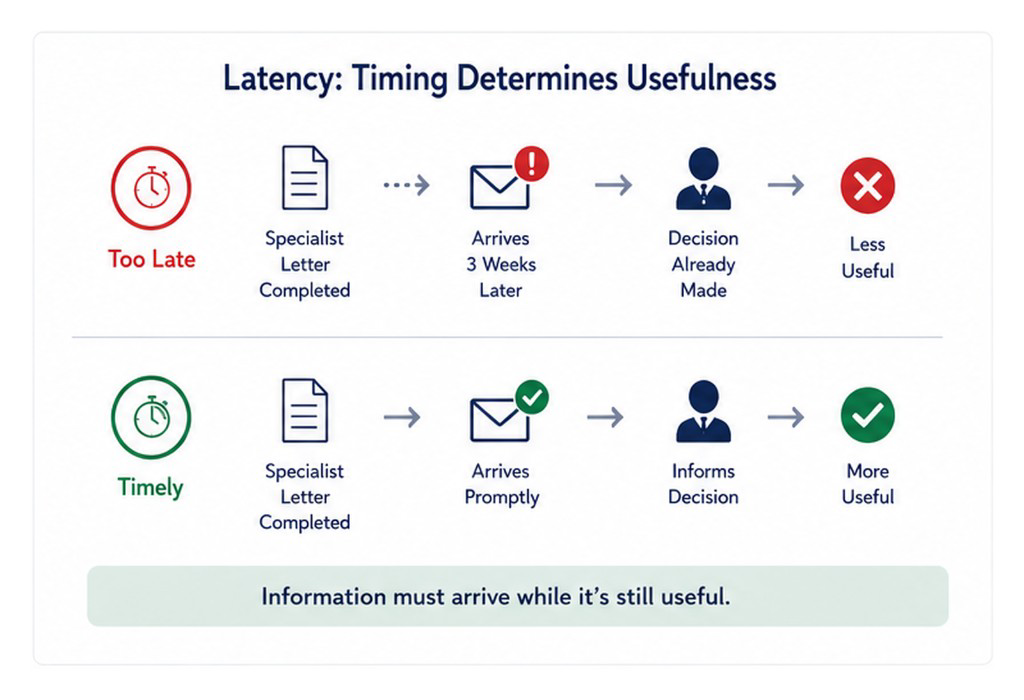
Correct information can still be less useful when it arrives after the decision.
So, the problem we’re really trying to solve is pretty simple to state:
| can we preserve the meaning of clinical information while reducing the time it takes for that information to reach the next person who needs it? That turns out to be a much harder problem than transcription because it involves continuity, provenance, responsibility and timing, not just words. Once you start thinking about the problem that way, the limitations of a document-only model become fairly obvious.
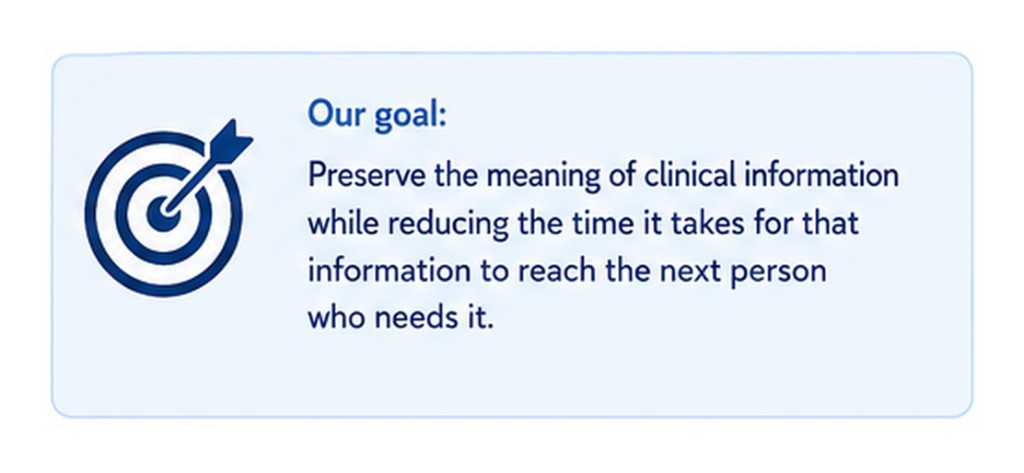
Fidelity and low safe latency have to be improved together.
Healthcare systems still revolve around documents, and that’s understandable. I want a consultation letter. I want an operation report. A GP needs correspondence. A hospital needs a discharge summary. The problem comes when those documents become the only practical way of understanding the patient over time. Patients don’t move from PDF to PDF. Their condition changes between those documents: pain improves, or it doesn’t; power changes; a scan becomes available; a diagnosis becomes more certain; a medication is started; a treatment fails; a result remains outstanding; a referral that was supposed to happen still hasn’t happened.
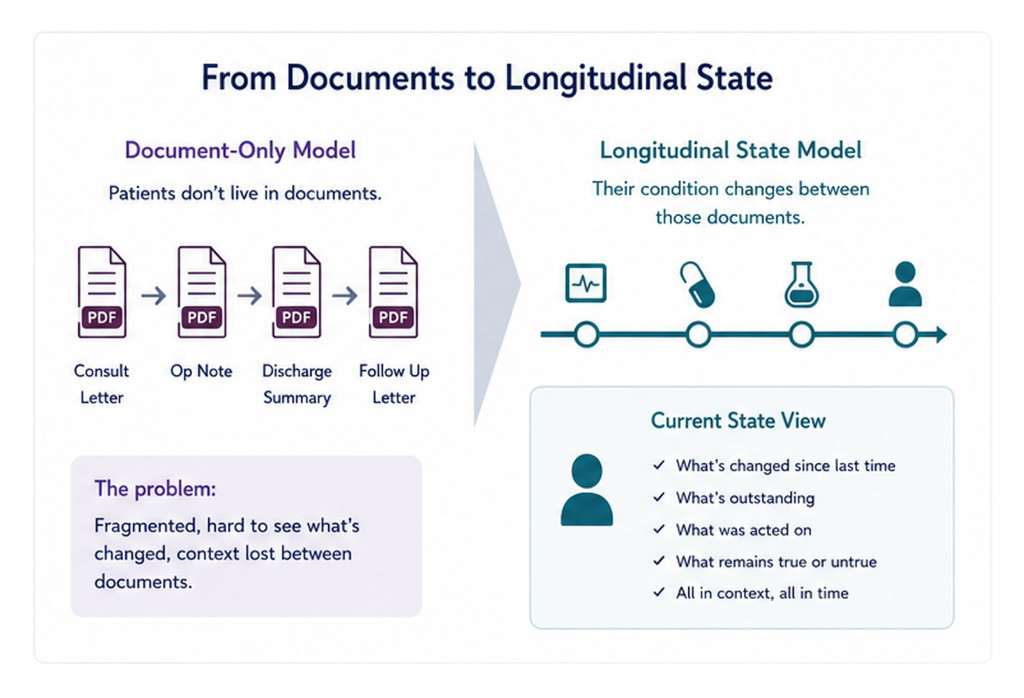
Documents remain necessary, but clinicians also need a current view of what has changed.
When I review somebody again, I rarely want to reconstruct every previous consultation from scratch. I want the previous context, of course, but most of my attention is on what’s different now. Clinicians do that naturally. Our information systems still make us rebuild it manually, and that has changed how we think about Regenemm Voice.
Voice is a very good way of reducing friction at the point where clinical information is created, but once we became better at capturing the encounter, it became obvious that capture alone wasn’t enough. We needed to retain the relationships around the information: where a statement came from, when it applied, whether it was something the patient said, something I observed, or something demonstrated on an investigation, whether it’s still true, whether another source has contradicted it, and whether anybody has actually acted on it.
Those questions take you away from the idea of a simple AI scribe and towards something much more longitudinal. They also make provenance and governance far more important. For us, provenance isn’t a compliance label added afterwards. It’s part of whether the information remains clinically trustworthy as it moves through the system.
There’s also a tendency in AI to treat reduced human involvement as evidence of progress. I don’t think that’s always a particularly useful way to think about medicine. I’m very happy for AI to do more of the information work. It can retrieve, organise, compare, draft and point out something I may want to look at. What I don’t want is a system quietly converting its own interpretation into clinical truth without an appropriate clinician being involved. The technology can remove a great deal of clerical and cognitive friction, but it shouldn’t remove clinical accountability.
The AI scribe has shown that AI can sit naturally inside a consultation, and I suspect we’ll eventually look back on that as the first layer. The bigger opportunity is what happens between consultations: whether we can make it easier to see what’s changed, tell when something that was supposed to happen hasn’t happened, and carry the relevant state through nursing, medical and organisational handovers without forcing the next person to reconstruct the whole story.
That’s the problem we’re increasingly interested in at Regenemm healthcare. A clinical encounter isn’t only a document-producing event. It’s also a change in state.
Author Dr Brendan O'Brien
Date. 2026-06-04